
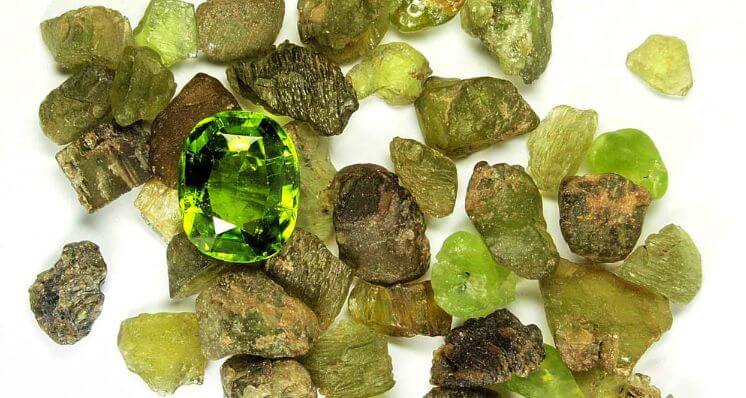
Peridot is one of the few gemstones that occurs in nature in only one color – elegant, timeless green, whose spectrum can range from the shade of juicy tropical sea celadon to the color of a freshly fallen leaf. The stunning variability of the stone’s color tones caused peridot to be mistaken for emeralds for centuries.
ORIGIN
The name peridot probably comes from the Arabic word faridat, meaning ‘jewel’.These stones can be found in mafic and ultramafic rocks, occurring in lava and peridotite xenoliths of the mantle; they usually occur in silica-poor rocks, such as volcanic basalt and pallasite meteorites.Peridot is one of only two gemstones known to science that formed not in the Earth’s crust, but in the molten rock of the upper mantle, from where they were brought to the surface by volcanoes and tectonic plate activity.
GEM OF THE SUN
Considered one of the oldest gemstones in the world, peridot was discovered as early as 1500 BCE. Records indicate that The first stones were found on the island of Topazo (now known as St. John’s) in the Egyptian Red Sea. According to legend, the stones glowed with a green light even at night. For this reason, the ancient Egyptians called peridot the “sun gem”. Today it is the national gem of Egypt.
OCCURRENCE
Today, the largest sources of peridot are the United States, Burma, Pakistan, and the Himalayas. It is also mined in Australia, Brazil, China, Egypt, Kenya, Mexico, Norway, Saudi Arabia, South Africa, Sri Lanka, and Tanzania.
STONE CHARACTERISTICS
Peridot has a hardness of 6.5 – 7 on the Mohs scale, which means it is a relatively soft gemstone, best suited for small earrings and pendants. The intensity, depth, and shade of green depend on the percentage of iron in the crystal structure, so the color of individual peridot gems can range from yellow, through olive, to brown-green. The chemical formula of peridot is as follows: Mg Fe2SiO4.
Fun fact:
The Pallasite meteorite, found in Fukang, China, contained olive-green peridot crystals in its structure, which is why some call peridot a cosmic stone. Extraterrestrial peridot, however, is extremely rare and is unlikely to be found in a retail jewelry store.
WHAT DOES PERIDOT HAVE IN COMMON WITH DIAMONDS?
Most gemstones form in the Earth’s crust. However, peridot forms much deeper, in the so-called Earth’s mantle. The only other gemstone known to us that also originates in the Earth’s mantle is diamonds. Although peridot forms in the upper mantle, it is still found at a depth of about 100 km, and the only way for peridot to naturally reach the surface is through volcanic activity.
CUSTOM JEWELRY WITH PERIDOTON ORDER WITH PERIDOT
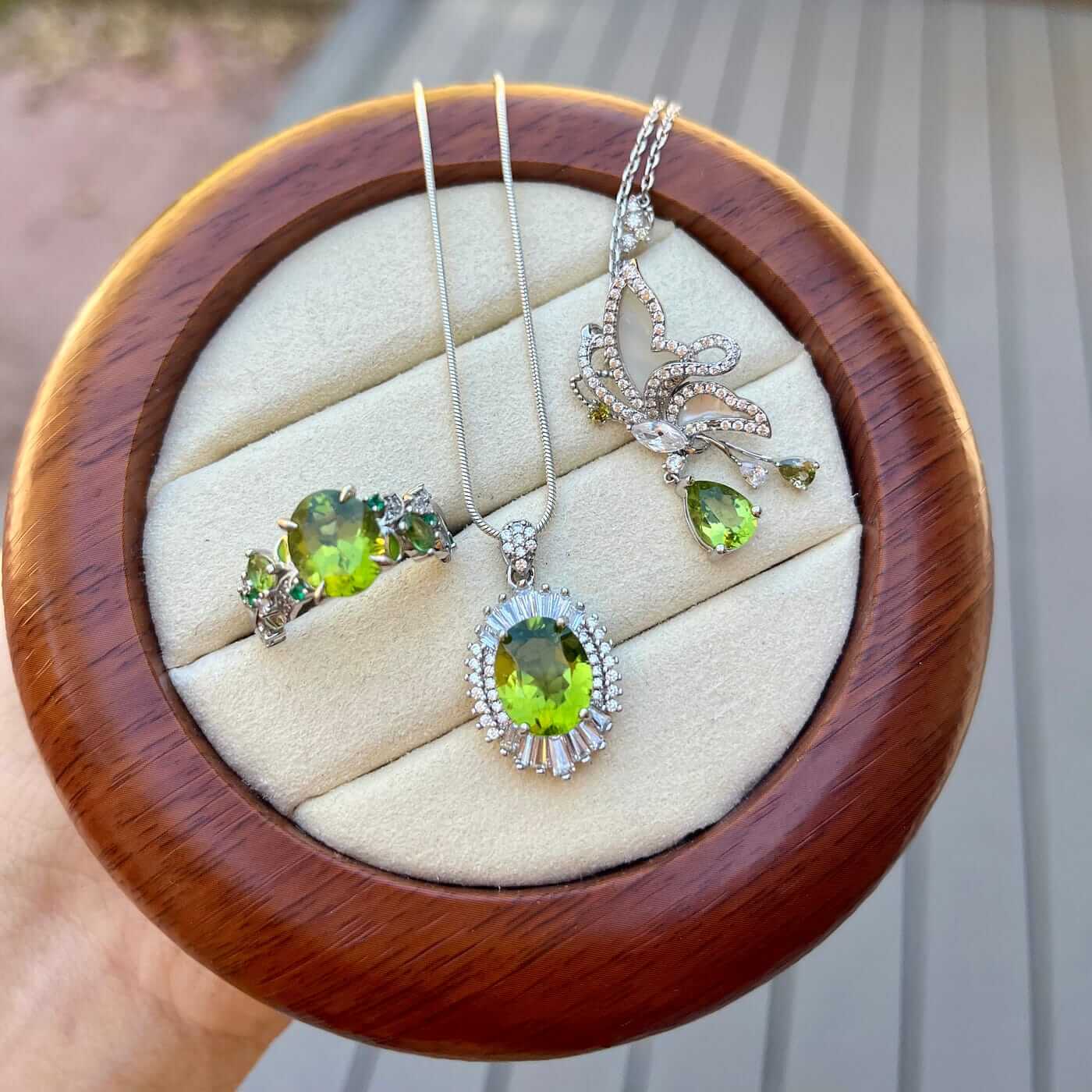
Each month of the year is characterized by a unique vibration that harmonizes with the frequency of various precious and semi-precious stones. Following this line, peridot is associated with August – this month is associated with long, summer evenings, bliss, and relaxation. Perhaps that is why it is said that this stone has ‘powers’ – it is known for attracting love and peace, and for ensuring a good night’s sleep. Regardless of whether you are looking for a ‘booster’ of relaxation, dreaming of a new relationship, or simply seeking a beautiful, colorful gemstone for your collection, rings, pendants, and other jewelry with green peridot will be Answering your needs. Contact the jewelry designer from the 79 Diamonds studio – together you will design a one-of-a-kind piece for yourself or your loved ones!
SETTING
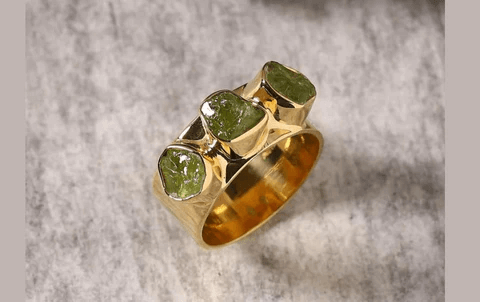
The warmth of peridot enhances the setting of the stone in yellow gold, but its rich apple color also beautifully stands out against silver. Even in its natural, uncut form, the distinct green shade of peridot is extremely consistent – a feature rarely found in gemstones. Peridot it is not enhanced or heat-treated to improve its color and intensity. Because peridot is often found in large sizes, the stone is an excellent material for skilled jewelers.